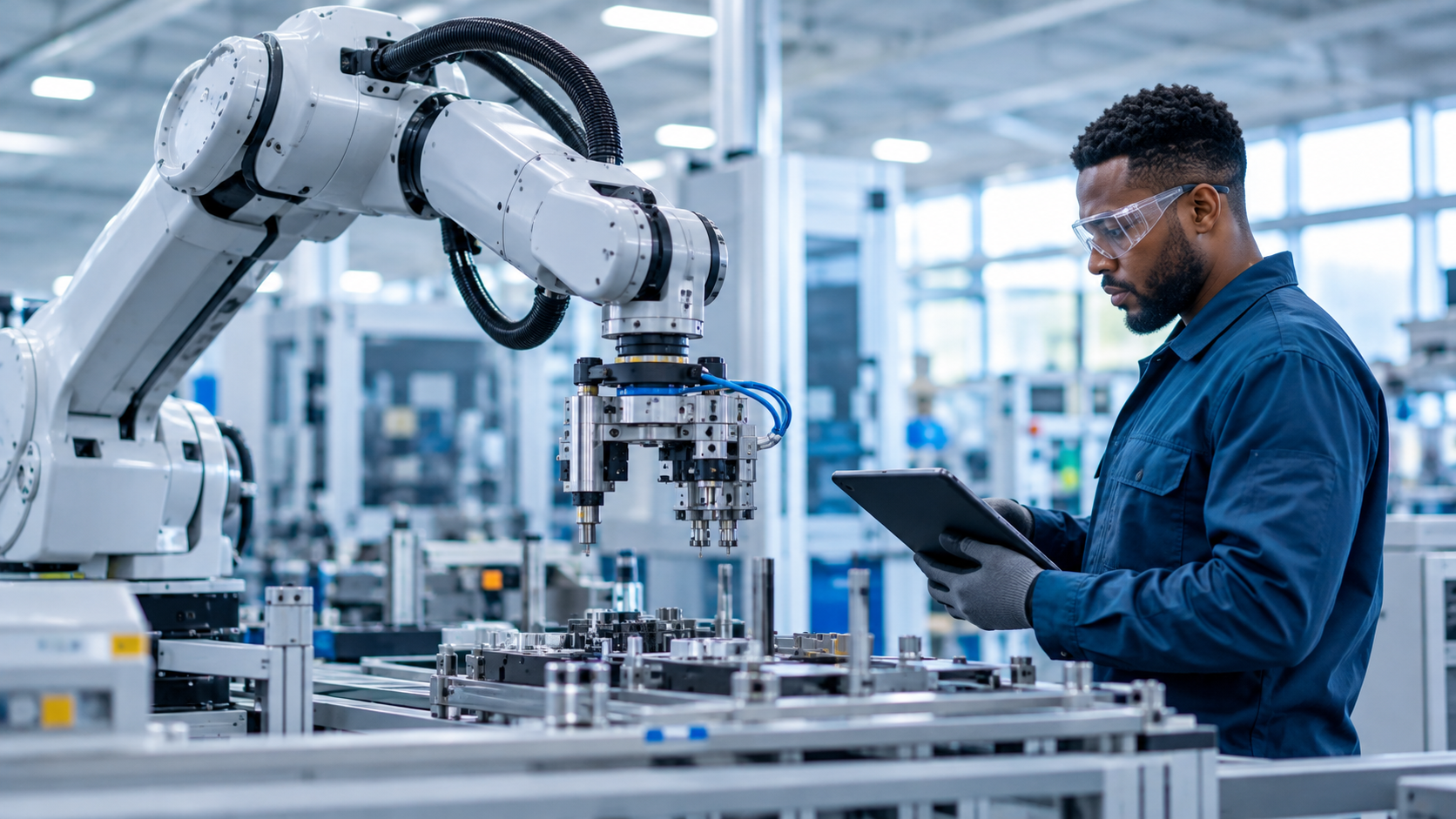
Manufacturing is entering a new era of intelligence driven by Artificial Intelligence (AI), Industrial IoT, robotics, advanced analytics, and automation.
Manufacturers are under increasing pressure to reduce costs, improve productivity, increase operational visibility, address labor shortages, minimize downtime, and maintain product quality while remaining competitive in rapidly evolving global markets.
Traditional manufacturing approaches often rely on reactive decision-making, manual processes, and fragmented operational data. AI is changing that.
Today, manufacturers can leverage AI to monitor equipment performance, predict failures before they occur, automate inspections, optimize production schedules, improve quality control, and make data-driven decisions in real time.
As Industry 4.0 continues to reshape industrial operations, AI is rapidly becoming one of the most valuable technologies in modern manufacturing.
Why AI Matters in Manufacturing
Modern manufacturing facilities generate enormous amounts of operational data from:
- Production equipment
- Industrial sensors
- Manufacturing execution systems (MES)
- ERP platforms
- Supply chain systems
- Quality management systems
- Warehouse operations
- Connected devices
Historically, much of this data remained underutilized.
AI enables manufacturers to extract value from operational data and convert it into actionable intelligence that improves performance across the production lifecycle.
Benefits include:
- Increased equipment uptime
- Improved product quality
- Lower operating costs
- Faster production cycles
- Better resource utilization
- Enhanced workplace safety
- Reduced waste
Organizations that integrate AI into manufacturing operations gain a significant competitive advantage.
Predictive Maintenance
Predictive maintenance is one of the most impactful AI applications in manufacturing.
Traditional maintenance strategies generally fall into two categories:
Reactive Maintenance
Repair equipment after it breaks.
Scheduled Maintenance
Maintain equipment based on fixed schedules, regardless of actual condition.
Both approaches can be costly and inefficient.
AI-powered predictive maintenance continuously monitors equipment health and predicts potential failures before they occur.
Data Sources
- Vibration sensors
- Temperature sensors
- Pressure sensors
- Current sensors
- Machine logs
- Historical maintenance records
Benefits
- Reduced downtime
- Lower maintenance costs
- Improved equipment lifespan
- Better production planning
- Increased operational reliability
Manufacturers can identify issues days or weeks before failures occur, avoiding costly interruptions.
Automated Quality Inspection
Maintaining consistent product quality remains a major challenge in manufacturing.
Traditional inspection processes often involve:
- Manual inspection
- Sampling methods
- Human judgment
- Labor-intensive activities
AI-powered computer vision systems can inspect products in real time.
Applications
- Surface defect detection
- Product measurement verification
- Assembly validation
- Packaging inspection
- Quality assurance checks
Benefits
- Higher inspection accuracy
- Faster quality control
- Reduced product defects
- Lower rework costs
- Improved customer satisfaction
AI-based inspection systems often identify defects too small or too subtle for human operators to consistently detect.
Production Optimization
Factories contain countless decisions that affect throughput and efficiency.
Examples include:
- Machine utilization
- Production sequencing
- Resource allocation
- Labor scheduling
- Production planning
AI systems analyze operational data and recommend process improvements that maximize efficiency.
Areas of Optimization
- Production schedules
- Equipment utilization
- Resource allocation
- Facility throughput
- Bottleneck reduction
Benefits
- Increased output
- Reduced production delays
- Improved operational efficiency
- Better resource planning
AI enables manufacturers to continuously improve operations instead of relying solely on periodic reviews.
Demand Forecasting
Accurate demand forecasting directly impacts profitability.
Poor forecasting often results in:
- Excess inventory
- Stock shortages
- Production inefficiencies
- Lost revenue opportunities
AI improves forecasting accuracy by analyzing:
- Historical sales data
- Seasonal demand patterns
- Market trends
- Customer behavior
- Supply chain conditions
Benefits
- Better inventory planning
- Improved customer service
- Lower carrying costs
- Reduced waste
- Increased profitability
More accurate forecasts enable manufacturers to produce the right products at the right time.
Supply Chain Intelligence
Supply chains have become increasingly complex and vulnerable to disruption.
AI helps manufacturers improve visibility across:
- Suppliers
- Warehouses
- Transportation networks
- Inventory systems
- Distribution operations
AI Applications
- Supply chain risk analysis
- Inventory optimization
- Supplier performance monitoring
- Logistics forecasting
- Procurement intelligence
Benefits
- Greater resilience
- Improved visibility
- Reduced disruptions
- Better decision-making
- Lower supply chain costs
AI helps organizations anticipate risks before they impact production.
Smart Factory Operations
AI is a foundational technology behind modern smart factories.
A smart factory combines:
- Artificial Intelligence
- Industrial IoT
- Edge Computing
- Robotics
- Advanced Analytics
Digital Twins
to create highly connected operational environments.
Smart Factory Capabilities
- Real-time monitoring
- Automated alerts
- Intelligent workflows
- Autonomous decision support
- Asset optimization
- Performance analytics
Benefits
- Increased operational visibility
- Faster response times
- Improved productivity
- Better business outcomes
Facilities become proactive rather than reactive.
Energy Consumption Optimization
Energy costs represent a significant expense for many manufacturers.
AI enables organizations to monitor and optimize energy usage across production environments.
Monitored Assets
- Motors
- Compressors
- HVAC systems
- Production equipment
- Utilities infrastructure
Benefits
- Lower energy consumption
- Reduced operating expenses
- Improved sustainability
- Better ESG performance
AI can identify inefficiencies that may otherwise go unnoticed.
Workforce Productivity Enhancement
AI is not replacing manufacturing workers. Instead, it is helping employees become more productive.
AI Supports Workers By
- Automating repetitive tasks
- Providing decision support
- Delivering real-time insights
- Improving training programs
- Enhancing operational communication
Examples
- AI-powered work instructions
- Digital assistants
- Intelligent scheduling
- Safety monitoring systems
Benefits
- Higher productivity
- Better decision-making
- Reduced errors
- Enhanced employee experiences
Organizations can leverage AI to augment human expertise rather than replace it.
Inventory Optimization
Inventory management directly affects profitability.
Maintaining excessive inventory increases costs while insufficient inventory creates production challenges.
AI helps organizations balance inventory levels through:
Capabilities
- Demand forecasting
- Safety stock calculations
- Procurement optimization
- Warehouse intelligence
Benefits
- Lower inventory carrying costs
- Reduced shortages
- Better customer fulfillment
- Improved cash flow
Manufacturers gain greater control over inventory performance.
Digital Twins & Operational Intelligence
Digital twins are virtual representations of physical assets, equipment, production lines, or entire factories.
When combined with AI, digital twins become powerful operational intelligence platforms.
Applications
- Production simulations
- Asset monitoring
- Capacity planning
- Process optimization
- Maintenance forecasting
Benefits
- Improved visibility
- Faster decision-making
- Better planning
- Reduced operational risk
Digital twins allow organizations to test scenarios before making real-world operational changes.
AI Use Cases by Manufacturing Sector
Automotive Manufacturing
AI supports:
- Quality inspection
- Robotics
- Predictive maintenance
- Production scheduling
Food & Beverage Manufacturing
AI improves:
- Quality assurance
- Demand forecasting
- Supply chain visibility
- Inventory management
Electronics Manufacturing
AI helps with:
- Defect detection
- Production monitoring
- Precision manufacturing
- Process optimization
Aerospace Manufacturing
AI supports:
- Asset management
- Quality control
- Maintenance planning
- Supply chain optimization
Medical Device Manufacturing
AI improves:
- Regulatory compliance
- Production quality
- Traceability
- Inspection processes
Challenges Manufacturers Must Address
Successful AI adoption requires planning and governance.
Data Quality
Accurate operational data is essential.
Legacy Systems
Many facilities operate older equipment that requires integration.
Workforce Adoption
Employees require training and change management support.
Cybersecurity
Connected manufacturing environments create additional security requirements.
Integration Complexity
AI must connect with MES, ERP, SCADA, and Industrial IoT environments.
Organizations that address these challenges early typically achieve faster and more sustainable results.
The Future of AI in Manufacturing
Over the next decade, AI will increasingly enable:
Autonomous Production Systems
Systems capable of self-adjusting based on operational conditions.
AI-Powered Digital Workers
Virtual assistants supporting operators, supervisors, and engineers.
Self-Healing Equipment
Machines identifying and correcting issues before failures occur.
Advanced Robotics
More intelligent and adaptable robotic systems.
Sustainable Manufacturing
AI-driven optimization of resources, energy consumption, and emissions.
Manufacturing facilities will become more connected, automated, and intelligent than ever before.
Artificial Intelligence is fundamentally changing the manufacturing industry.
From predictive maintenance and quality inspection to production optimization, supply chain intelligence, and smart factory operations, AI helps manufacturers improve performance, reduce costs, increase reliability, and strengthen competitiveness.
Organizations that embrace AI today will be better positioned to navigate future challenges, accelerate innovation, and lead the next generation of manufacturing excellence.
As Industry 4.0 continues to evolve, AI will become a core capability powering intelligent manufacturing operations worldwide.